
Subnational data reveal a very strong link between food and political insecurity in West Africa. Regions subject to food insecurity are not only prone to more violence, but conflict is more concentrated spatially than in other regions.
More food insecurity in conflict regions
This correspondence is particularly evident when disaggregated food security data is superimposed on violent events. From June to November 2023, for example, many conflict-affected regions also experienced food crises, such as the Lake Chad basin, the Central Sahel, and northwestern Nigeria, as shown below.

This correspondence is not perfect, of course. In 2023, eastern Senegal experienced a difficult food situation without armed conflict. Similarly, many violent incidents have been observed in the Niger River Delta, yet the food situation there is not bad.
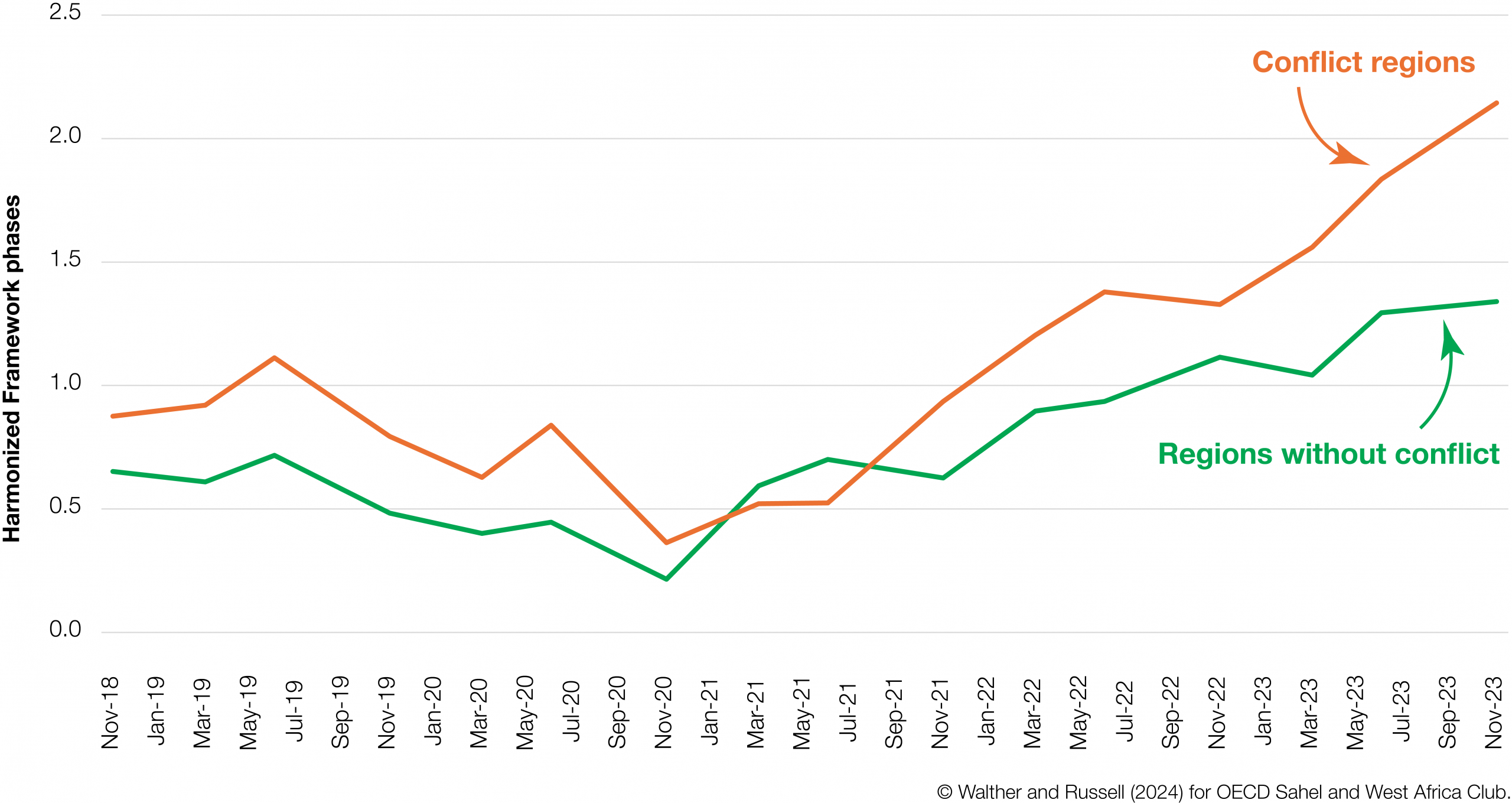
In general, however, conflict-affected regions across West Africa are also those where food insecurity is most severe. Since November 2018, the Harmonized Framework Index, which measures acute food and nutrition insecurity, has consistently been higher in conflict-affected regions than in peaceful regions, as shown below.
Combining two indicators
To further examine the extent to which food and political insecurity are linked, we recently combined two approaches developed by policymakers and spatial analysts over the past few decades.
For one approach, we used data from the Harmonized Framework (also known as Cadre Harmonisé), which builds on an international classification scale based on five different phases, ranging from minimal food insecurity to famine.
For the second approach, we used data on political violence collected by Armed Conflict Location and Event Data (ACLED) project to construct a Spatial Conflict Dynamics indicator, or SCDi, which determines whether violence is more or less intense and more or less concentrated in space.
We then combined the five phases of the Harmonized Framework, from 1 to 5, with the four types of conflict from the Spatial Conflict Dynamics indicator, to which we added areas without conflict. This gave us 25 possible situations, as shown below.

The results of this preliminary analysis were presented at the Food and Prevention Network (RPCA) meeting in April 2024. The RPCA was created in 1984 by members of the Permanent Interstate Committee for Drought Control in the Sahel (CILSS) and of the OECD Sahel and West Africa Club to monitor food security in West Africa.
Violence is more clustered in food-insecure regions
Our work suggests that the most acute food insecurity often corresponds to the most geographically concentrated violence. In other words, it is where violence occurs repeatedly in specific places that the risk of food insecurity is greatest.
This is particularly visible in areas where violent insurgencies have developed, such as the Liptako-Gourma between Burkina Fasom Mali and Niger, and around Lake Chad, the regions most affected by food insecurity in June 2019.
Four years later, the Liptako-Gourma hotspot remains problematic, and the violence has now spread to Burkina Faso’s eastern borders due to the diffusion of Jihadist groups.

To confirm that the regions with the highest average food insecurity are those where violence is occurring repeatedly in the same places, we plotted the different types of violence from the SCDi and compared them with the food security indicator over time.
On the figure below, the green line representing the average food insecurity scores for regions not experiencing conflict is consistently below the red and orange lines representing conflict regions.

By repeatedly attacking the same markets, roads, and villages, armed groups are destroying the infrastructure that enables goods to circulate in the region.
In some areas of the Central Sahel and Lake Chad basin, farmers can no longer cultivate their fields by fear of being kidnapped or killed, while traders are reluctant to supply agricultural and industrial goods to markets and cities.
This development has serious consequences for the economies of West African countries, which are heavily dependent on intra-regional trade.
Acknowledgments
The authors would like to thank Marie Trémolières, Lacey Harris-Coble, Steve Radil, and Jose Luis Vivero, The views expressed in this post are those of the authors and do not necessarily reflect the official policy or position of the OECD, CILSS or RPCA.
By Olivier Walther and David Russell, 8/8/2025.